This chapter aims to support Research and Innovation Funding Organisations in embedding Inclusive Gendered Innovation (IGI) into their everyday work. It is intended for programme managers, evaluators, policy officers, and others involved in funding or reviewing research and innovation projects.
What you find here is based on real-world experience. It draws on case studies from the INSPIRE project, including:
- Vinnova (Reidl and Beranek, 2025)
- FFG (Schiffbänker and Walker, 2025)
- The European Commission (Holzinger et al., 2025)
- FONRID (Wienand and Araki, 2025)
It also builds on a comparative report on RFOs and extensive input from the INSPIRE Community of Practice (CoP) made up of representatives of RFOs across the globe. We thank our CoP members for helping shape this chapter into a tool that reflects real needs and tested solutions.
How to use this Chapter
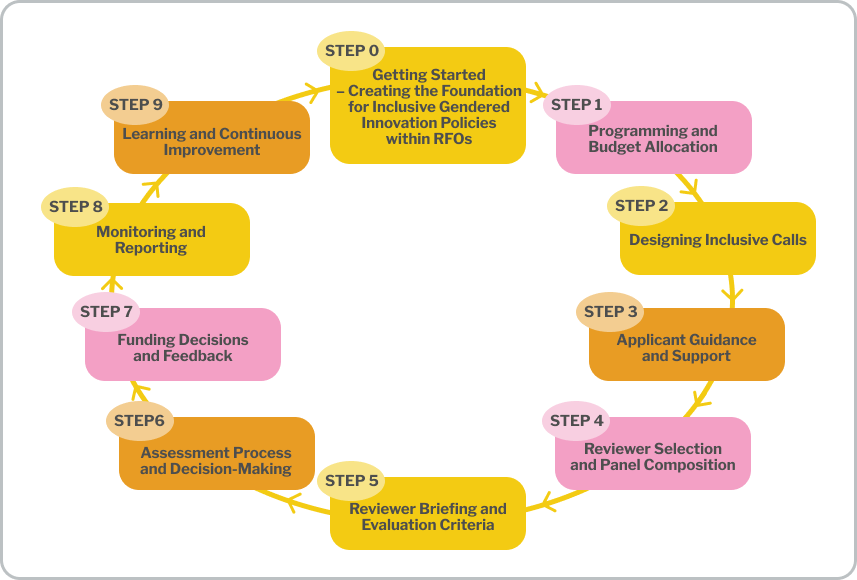
To fit different starting points and needs, this chapter is structured as a modular guide. It includes 10 steps (Steps 0–9) that follow the main stages of the research and innovation funding cycle. You can go through the steps in sequence or pick the ones most relevant to your current work. Each step provides practical entry points to strengthen inclusion across your organisation.
The steps are:
- Step 0: Getting Started – Creating the Foundation for Inclusive Gendered Innovation Policies within RFOs
- Step 1: Programming and Budget Allocation
- Step 2: Designing Inclusive Calls
- Step 3: Applicant Guidance and Support
- Step 4: Reviewer Selection and Panel Composition
- Step 5: Reviewer Briefing and Evaluation Criteria
- Step 6: Assessment Process and Decision-Making
- Step 7: Funding Decisions and Feedback
- Step 8: Monitoring and Reporting
- Step 9: Learning and Continuous Improvement
Not sure where to start?
Use the infographic below as the main navigation through the funding cycle. If you prefer a text-based overview, open the quick orientation guide here. The downloadable PDF also includes this guide at the beginning.
| If you want to… | Start here |
|---|---|
| understand what Inclusive Gendered Innovation means and why it matters, and make the case for it in your organisation | Introduction: key terms, relevance, and challenges |
| build internal foundations and create the conditions for inclusive policies | Step 0: Getting Started |
| integrate IGI into your funding programmes and budget planning | Step 1: Programming and Budget Allocation |
| design inclusive calls that embed gender and diversity expectations | Step 2: Designing Inclusive Calls |
| develop guidance and support for applicants | Step 3: Applicant Guidance and Support |
| select reviewers and compose evaluation panels | Step 4: Reviewer Selection and Panel Composition |
| brief reviewers and develop inclusive evaluation criteria | Step 5: Reviewer Briefing and Evaluation Criteria |
| ensure the assessment process and decision-making are fair and inclusive | Step 6: Assessment Process and Decision-Making |
| provide transparent funding decisions and feedback | Step 7: Funding Decisions and Feedback |
| monitor progress and report on IGI integration across your funding cycle | Step 8: Monitoring and Reporting |
| build in reflection loops and support long-term learning | Step 9: Learning and Continuous Improvement |
| clarify concepts such as sex, gender, diversity, intersectionality, IGI, or IGIP | Glossary |
Start with four questions:
- Who is affected by the research and innovation your organisation funds?
- Who might benefit less, be excluded, or face different barriers?
- Which sex, gender, or diversity dimensions could shape needs, access, or outcomes?
- How will your programme design, call texts, evaluation criteria, applicant support, and monitoring respond to this?
Are you a programme manager, evaluator, or policy officer looking to make your research and innovation funding organisation more inclusive? Our 10-step guide drawing from real-world experience can help. Click on any of the steps in the infographic below to explore them in detail .
What You’ll find in each Step
Each step follows the following structure:
- A short introduction explains where the step fits into the funding cycle and how it contributes to more inclusive gendered innovation.
- Learning goals show what your team can reflect on, decide, or put in place by the end of the step.
- Common challenges, based on insights from other funding organisations, help you anticipate typical barriers and think through possible responses.
- Practice-based action points, examples, and tools support you in applying what you’ve learned in your own context.
The steps move from early groundwork to long-term improvement. You can follow them in order or focus on the ones that best fit your current priorities.
For those who prefer a guided learning format, OTU7: Inclusive Gendered Innovation Policy Toolkit is also available on the INSPIRE e-learning platform: https://inspire.europamedia.org/e-learning/chapter/67/otu7-inclusive-gendered-innovation-policy-toolkit . OTU7 and SPK5 are designed to be used together: OTU7 as an accessible entry point, SPK5 as the detailed reference guide.