The final year of the project is very intensive for WIGE Community of Practice. WIGE brings together gender equality experts and researchers, mostly from Central and Eastern Europe, who share their experiences and good practices - particularly regarding diverse approaches to monitoring Gender equality plans (GEPs). During monthly meetings, we exchange our experiences related to GEP monitoring, especially in the process of formulating new GEPs that build on those implemented in response to eligibility criterion introduced in 2021.
In addition, members have recently participated in two workshops. The first, “Engaging Stakeholders for Inclusive Gender Equality” led by Dr. Silvia Fierăscu from the West University of Timișoara, focused on enhancing collective capacity within institutions. During the workshop, we worked on five key challenges in GEP implementation (e.g. invisible labour, burnout and structural redistribution; turning symbolic support into accountable action; intersectionality; resistance and Backlash Dynamics).
The second online workshop “From Numbers to Narratives: Data Storytelling for Gender Equality Impact” was led by Dr. Anna Knapińska from the National Information Processing Institute in Warsaw and an INSPIRE KSH2 expert. The workshop aimed to support participants in transforming gender equality data into clear, relevant and persuasive narratives tailored to different stakeholder groups, including decision-makers. It provided a practical storytelling framework combining audience analysis, narrative structure, and high-quality data visualisation.
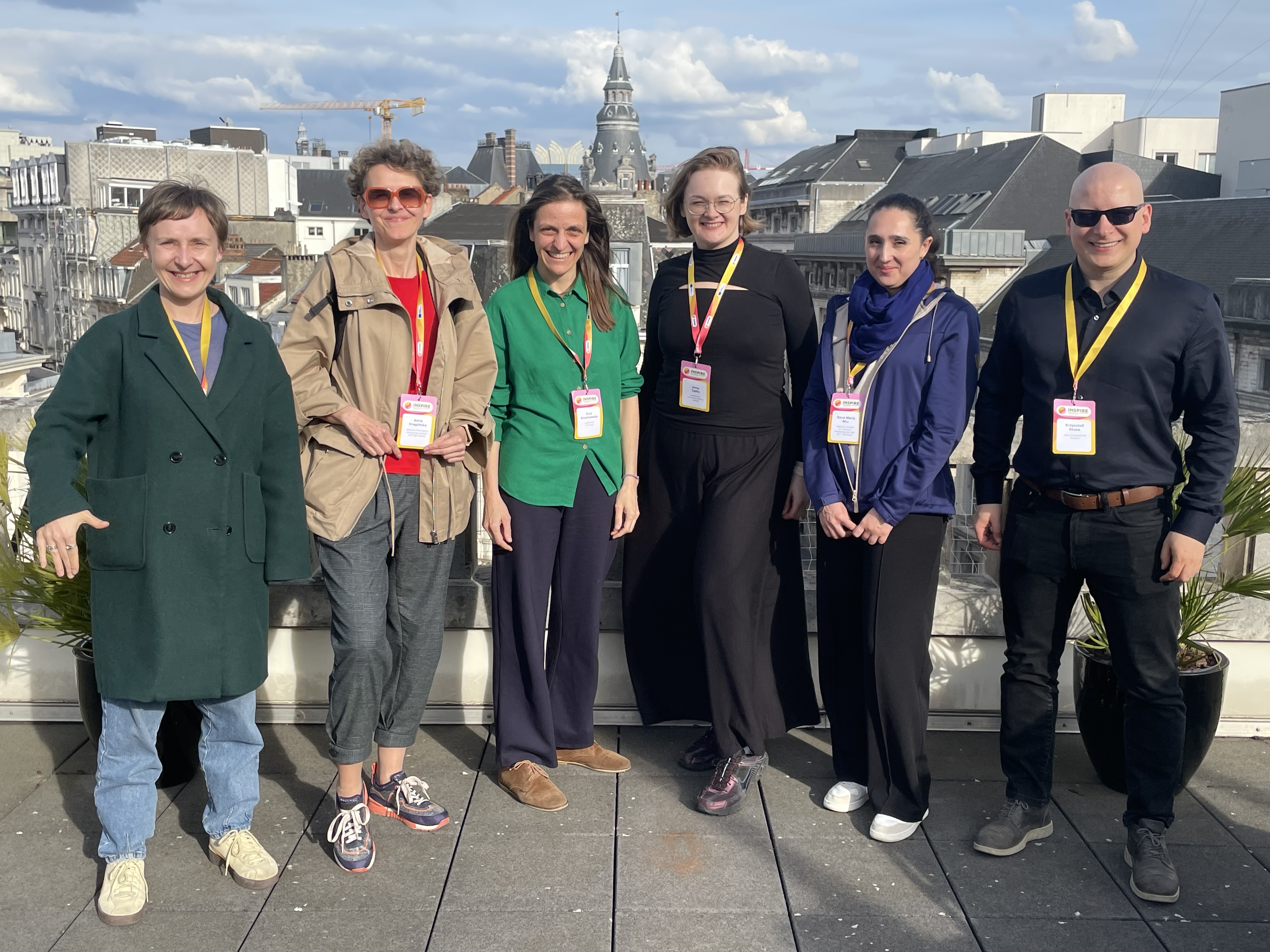
We also met in Brussels on 16-17 April 2026, on the occasion of the second INSPIRE conference. The representatives of our community Petroula Mavrikiou from Frederick University (Cyprus) and Ewelina Ciaputa, from the Jagiellonian University (Poland), participated in the panel discussion in the session “Communities of Practice as agents of change”. After the second day of the conference, we met at the WIGE CoP meeting, during which we worked on the sustainability of our activities beyond the conclusion of the project. Sustaining the work of such expert groups remains a challenge across many European projects. The Community hopes to continue sharing good practices related to inclusive Gender Equality Plans, as well as their monitoring and implementation in local contexts. As the photo shows, we aspire to reach high; at the same time we reflect on the resources and forms of collaboration that can realistically be sustain after projects ends.
By Ewa Krzaklewska & Paulina Sekuła, Jagiellonian University in Krakow